

HOW DID THE MONA LISA BECOME THE MOST FAMOUS PAINTING IN THE WORLD
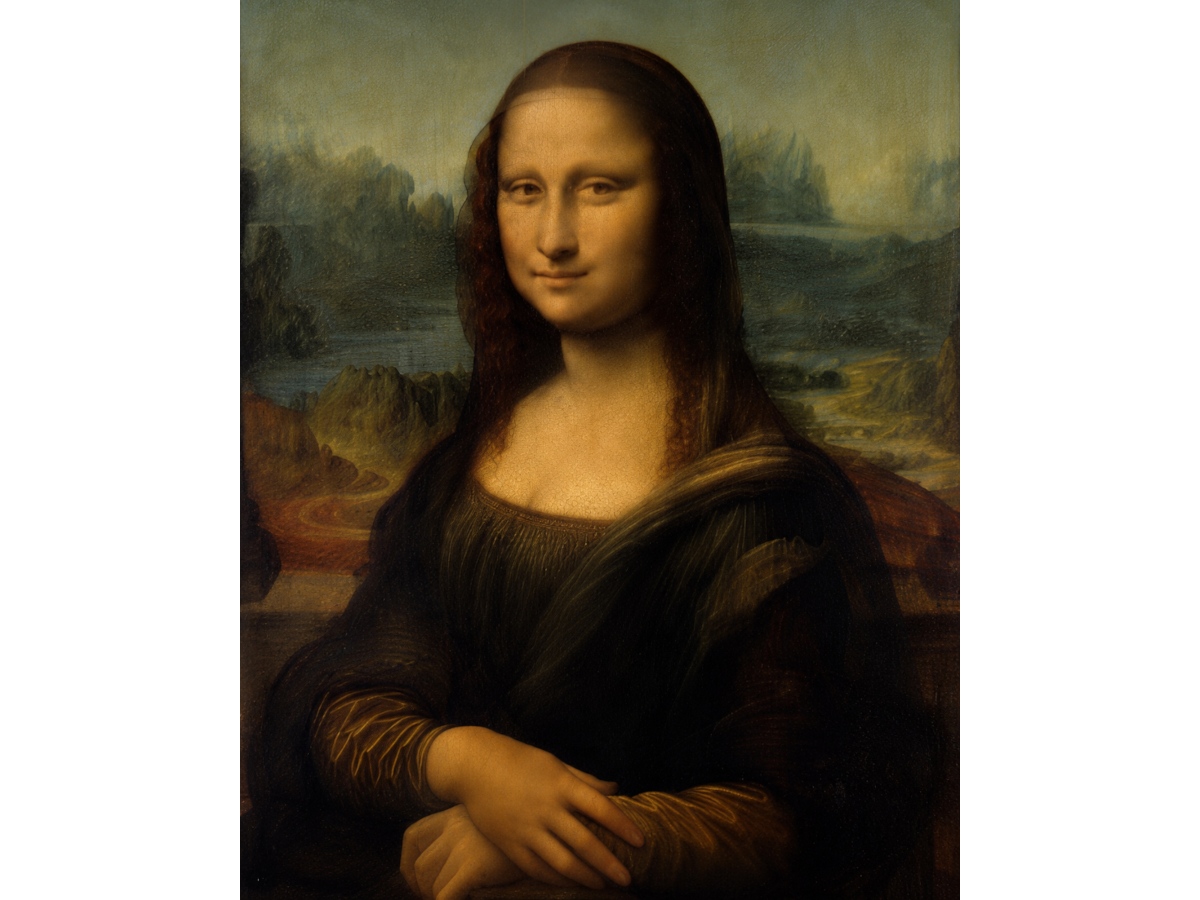
Without a doubt, the most famous painting in the world is the Mona Lisa by Leonardo da Vinci. This oil on wood panel was painted between 1503 and 1506. He, however, continued to periodically make revisions to the painting until 1517. At that time, he suffered from paralysis of his right hand. This is believed to be the reason the work was never completed. Measuring 30 inches by 21 inches, it has been on display in the Louvre Museum in Paris almost continuously since 1797.
It is estimated that there are tens of millions of paintings across 100,000 museums and cultural institutions in the world. The Louvre Museum alone is home to 7,500 paintings. So how did the Mona Lisa become the most famous painting in the world?
VINCENZO PERUGGIA
Vincenzo Peruggia was born in 1881 in a small village in the Italian Alps. In 1908, he moved to Paris and found work as a handyman. He was part of a group that built protective framing for artwork at the Louvre. Involved in constructing the frame for the Mona Lisa, he learned how to quickly remove her from the protective structure.
THE 1911 THEFT OF THE MONA LISA
On the morning of August 21,1911, workers began arriving at the museum, to start their workday. Peruggia had not been scheduled to work that day. It was the one day a week during the summer that the museum was closed to the public. He slipped into a typical white worker’s smock and joined the men as they filed into the museum.
Peruggia went directly to the Salon Carre, where the painting was hung between da Correggio’s Mystical Marriage and Titian’s Allegory of Alfonso d’Avalos. With the gallery empty, he lifted the painting off the wall and walked to a nearby stairwell. There he removed the protective case and frame. He hid these items behind some artwork stored in the stairwell. Removing his smock, he wrapped it around the painting. Peruggia then discovered he had locked himself in the stairwell. A plumber, believing he was working that day, kindly unlocked the door for him. He then proceeded to walk out of the museum with the painting under his arm. The robbery was not discovered until the following day.
THE MONA LISA
The Mona Lisa is a portrait of Lisa del Giocondo. The painting’s actual name is “La Gioconda”. This was her married name and in Italian means “the joyful one”. It is extraordinary for both her mysterious smile and the atmospheric smokiness of the painting. She was portrayed in the style of the Virgin Mary, as women were usually depicted in Renaissance paintings.
Lisa del Giocondo was the wife of a wealthy Florentine silk merchant, Francesco del Giocondo. It is believed that the painting was commissioned to celebrate the birth of their son. da Vinci, however, never parted with the painting, retaining possession until his death.
The painting was carried out in the sfumato technique which means “evaporate like smoke”. It eliminates sharp outlines and provides a soft blending of colors and tones. The backdrop is a remote dark landscape executed from an aerial perspective. da Vinci applied the oil paint in delicate, translucent layers which dried gradually. This allowed for a progressive transition from light to dark. It gave the face a gentle appearance. The model and landscape are in perfect balance. da Vinci’s method profoundly altered the way future portraits were executed and set a new standard.
WHY DID DI VINCI KEEP THE PAINTING
Even though the Mona Lisa was a commissioned piece, da Vinci never gave the piece to Francesco del Giocondo. He became fixated with perfecting the sfumato technique. This obsession caused him to consider the painting a work in progress, and he continued to make subtle changes to it for the rest of his life. His attachment to the painting was so profound that he would not travel anywhere without it. He believed it was going to be his crowning glory, his masterpiece and he was committed to making it flawless. da Vinci continued to modify the work for sixteen years, never completing the painting before his death.
He joined the royal court of King Francis I of France in 1516, near the end of his life. Mona Lisa traveled there with him. He left Italy because he was finding it difficult to obtain new assignments. There was an abundance of new masters competing with him for commissions. Joining the King’s court, the elderly artist was provided with a lavish chateau, handsome pension and the ability to paint whatever he desired.
When he died in 1519, his assistant inherited da Vinci’s personal collection of paintings. The King purchased the Mona Lisa for his royal collection. The painting then became the property of the French Republic.
After the French Revolution, the painting was relocated to the Louvre. It then spent some time in the bedroom of Napolean. During the Franco-Prussian War, it was again moved, this time to the Brest Arsenal and eventually made its way back to the Louvre.
THE INVESTIGATION
The Louvre made little effort to protect its collection in 1911. There were no admission charges and people came in and out of the museum at will. There were a limited number of guards compared to both the size of the museum and the number of guests. Rather than act as security, they operated managing crowds in galleries. It was not unusual for many galleries to remain unchecked for extended periods of time.
When the theft was discovered, over 60 police officers swarmed into the museum and searched for clues, confidant that they would quickly catch the culprit. The curator identified the employees who had contact with the painting. Peruggia’s name was among them.
IT CAUSED A SENSATION
Newspapers around the world seized on the story and sensationalized the robbery. It was splashed across their front pages with offers of rewards for information. It made the Mona Lisa the most recognizable face in the world. The museum closed its doors for a week as police combed through the museum searching for clues. When the Louvre reopened, incredibly, hordes of people dropped everything to rush to the museum to stare at the empty space where the Mona Lisa used to hang. Among the crowds was Franz Kafka.
Many more people visited the Louvre to stare at the blank space than the number of visitors who had previously viewed the painting. The theft and lack of police progress was becoming a national disgrace.
PABLO PICASSO AND GUILLAUME APOLLINAIRE WERE ARRESTED
Pablo Picasso and poet Guillaume Apollinaire were arrested and put on trial for stealing the Mona Lisa. Apollinaire’s former secretary, Gery Pieret created the situation that led to this. He had stolen small minor relics from the Louvre, which he sold to them. Picasso’s early cubist works were inspired by these artifacts. After the Mona Lisa disappeared, Pieret, who was an attention seeker and strapped for cash, tried to monetize the moment. He went to the Paris Journal newspaper and revealed that he had previously stolen items from the Louvre. He would provide them with a Phoenician statue he had stolen so they could break the story and prove the Mona Lisa was stolen due to the Louvre’s incredibly lax security. Pieret would do this in exchange for 50,000 francs ($300,000 in today’s dollars). This was the same amount of money the newspaper was offering as a reward for information on the Mona Lisa.
The newspaper had no interest in Pieret’s offer and called the police. Pieret then became a suspect. Aside from seeking money, he was also seeking vengeance against the Picasso and Apollinaire after a bitter falling out. He implicated Apollinaire who implicated Picasso. Both men were put on trial with Picasso vehemently repudiating that he knew Apollinaire, his good friend. He feared he would be deported to Spain if he was convicted. In the end, the judge realized neither had anything to do with the heist and they were let go.
OTHER SUSPECTS
At the beginning of the 20th century, American millionaires were snapping up the best paintings in France. At one point, J.P. Morgan was suspected of orchestrating the theft to add to his collection. When hostilities between France and Germany escalated prior to the First World War, the French started to suspect the Kaiser masterminded the heist.
THE INVESTIGATION CONTINUES
The police set out to interview all museum employees. Peruggia did not show up at the police station on the two occasions he had been instructed to. The police then went to his apartment and did a search. Finding nothing, they dismissed him as a suspect. While writing up the report of the visit, an officer leaned against a table under which was a trunk with a false bottom hiding the painting. The judge reviewing the case directed the police to consider the museum glazers as the prime suspects based upon the curator’s recommendation. The police dismissed this information.
Peruggia’s fingerprint was found on the protective glass safeguarding the painting he had left behind. The police were in possession of a photo and fingerprints of him due to a previous arrest. The police knew he had been part of the team creating the protective framing and was not working on the day of the heist. All employees of the museum were fingerprinted but Peruggia. The police forgot to add his name to the list.
PERUGGIA MAKES HIS MOVE
The painting remained in Peruggia’s apartment for two years. After seeing an antique dealer advertising in an Italian newspaper, he decided to make his move.
He traveled to Florence with the painting. Peruggia deluded himself into believing that he would be hailed a national hero and handsomely rewarded for returning the painting to Italy. He reached out to the owner of an art gallery, Alfredo Geri, who called the director of the Uffizi, Giovanni Poggi. He authenticated the painting then called the police and Peruggia was arrested. Rather than immediately return the painting to France, it was put on tour throughout Italy. At every stop, thousands of people flocked to see the Mona Lisa. Later that year, it was returned to the Louvre.
WHY DID HE DO IT?
Peruggia made the claim that he stole the painting for patriotic reasons. He believed the painting belonged to Italy not France, after it was stolen by Napoleon. While it was true that during the French Revolution and Napoleonic Wars, Napolean looted European artwork, the painting, had been purchased by King Francis I immediately following da Vinci’s death. It would not be until 200 years later that Napolean would even be born.
His claim that the sole purpose for stealing the painting was his love of Italy was nonsense. He made no attempt to donate the painting to an Italian museum but tried to sell it for profit. After he was arrested, it was revealed that he had previously taken the painting to London in an attempt to sell it. He approached well known London art dealer, Joseph Duveen. The art dealer took one look at the disheveled, poorly dressed Peruggia and laughed in his face. He assumed he was either insane or trying to sell him a fake. His true motives were proven by a letter he sent to his father proclaiming “I am making a vow for you to live long and enjoy the prize that your son is about to realize for you and for all our family.”
THE TRIAL
When he was put on trial in Florence, many Italians had great sympathy for the humble man who had successfully brought the treasured Mona Lisa back to Italy. This resulted in him receiving a lenient sentence of one year and 15 days. At the commencement of the trial the painting went on display in Florence. On the first day, 30,000 people stormed into the exhibit to see what had become a national treasure.
The story faded from international headlines shortly after the trial, when the First World War broke out. On appeal, Peruggia’s sentence was reduced to seven months.
LATER LIFE
After prison, he served Italy in the First World War. He was captured by the Austria-Hungary army and spent two years in a prisoner of war camp. He was released at the end of the war, married and had a daughter. He returned to France where he found work as a painter and decorator. Peruggia died at the age of 44 in 1925.
KEEPING THE PAINTING SAFE DURING WORLD WAR II
The painting was safeguarded during the Nazi occupation of France. In 1939, as the war was imminent, the painting was moved to Chateau d’Amboise, then was sent to Loc-Dieu Abbey, and finally to Musee Ingres in Montauban.
FAME BROUGHT CONTINUED ATTACKS ON THE PAINTING
The Mona Lisa, now the most famous painting in the world, has not experienced a quiet life since returning to the Louvre. Its fame has attracted many disgruntled and unstable people who set out to damage her.
Acid Attack and Rock Throwing Incidents
In 1956, the lower part of the canvas was damaged when someone poured acid onto the painting. Later that year, a small fleck of paint near the elbow was displaced when a Bolivian tourist threw a rock at the painting, shattering the protective glass.
Spray Painted
In 1974, a woman in a wheelchair attempted to spray paint the Mona Lisa while it was on loan to the Tokyo National Museum. She was protesting the lack of accessibility for the disabled at the museum. She only managed to damage the glass case.
Teacup Incident
In 2009, a Russian woman who had been turned down for French citizenship, sought her revenge on the Mona Lisa. After buying a ceramic teacup from the Louvre gift shop, she threw the cup at the painting. The bulletproof glass casing safeguarded the painting. The woman was removed and sent for psychiatric evaluation.
Spreading cake across the protective glass
In 2022, a man pretending to be a wheelchair bound elderly woman spread cake across the protective glass of the painting. He was protesting climate change. There was no damage to the painting.
Soup Splash
In 2024, pumpkin soup was tossed against the protective glass by two environmental activists.
THE MONA LISA TODAY
The theft of the Mona Lisa has been considered the 20th century’s greatest art heist. While the Mona Lisa had always been considered a masterpiece within the art world, it was one of a million around the world. The theft and subsequent worldwide headlines placed it on the world stage. It turned the Mona Lisa into the superstar of masterpieces. Tens of thousands of people visit the Louvre each day to see her. The painting is insured for $3 billion.
