
WHERE IS THE MISSING TREASURE OF AL CAPONE?
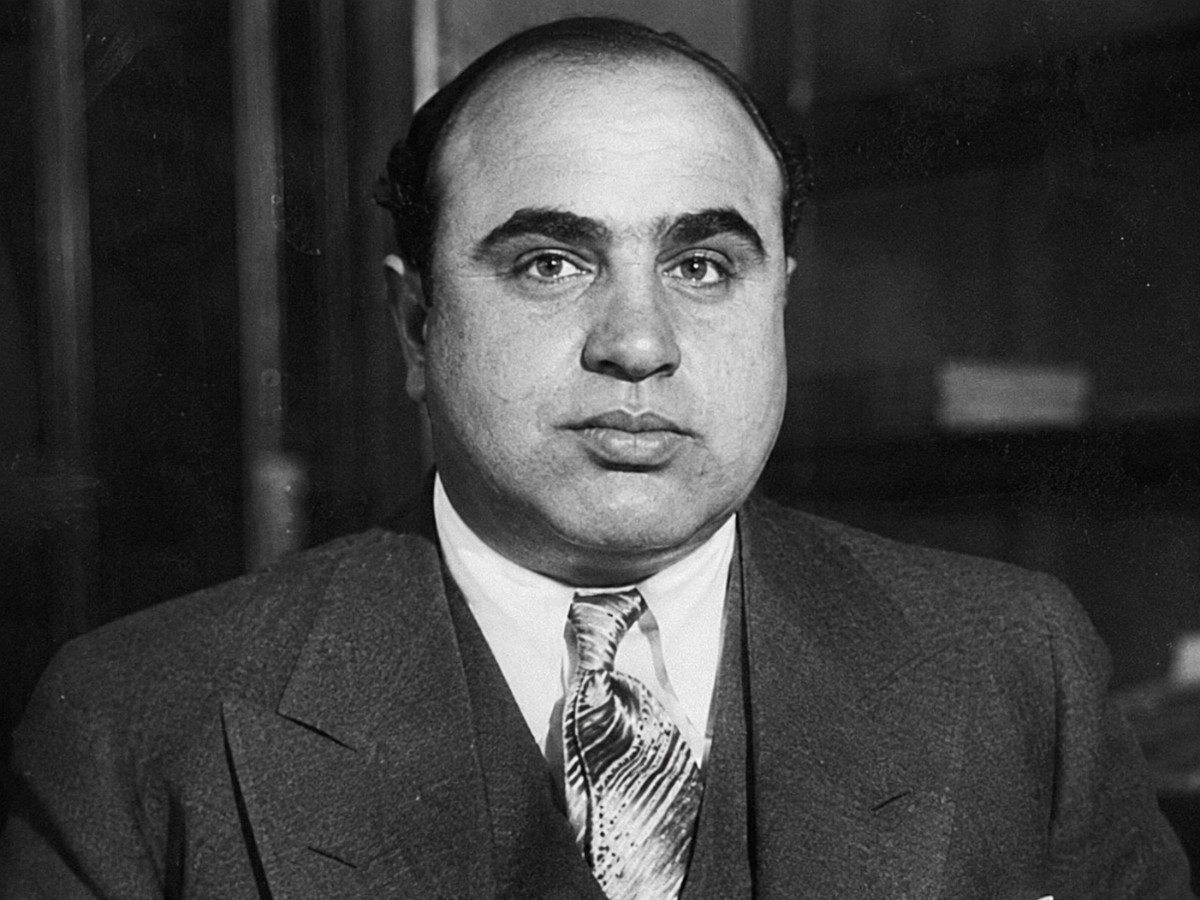
Al Capone has gone down in history as the most notorious gangster in America. Amazing considering he only operated his crime syndicate between 1925 to 1931. Capone’s dress and behavior set the stage for how mobsters would always be both perceived and portrayed. He was always dressed in his custom pinstriped suit, fedora hat and ostentatious jewelry, with a cocky attitude. His imagery would come to represent how a crime boss looked and acted. He created an image of himself that the newspapers ate up and the public adored. But who was Al Capone and where is his missing fortune?
PROMISING YOUNG MAN GOES BAD
He was born Alphonse Gabriel Capone in Brooklyn, New York in 1899 to Italian immigrant parents. A promising student, he was thrown out of school at 14 after striking a teacher. He worked a series of odd jobs before he became involved with some low-level gangs in Brooklyn. Moving up the ladder in crime, he joined the influential Lower East Side gangsters, the Five Points Gang. He then fell under the influence of a bartender at a Coney Island dance hall named Frankie Yale. While working at the dance hall, he insulted a woman, whose brother then slashed Capone across the left side of his face. This earned him the name Scarface. He was then taken under the wing of mobster Johnny Torrio, who ran a bootlegging operation.
THE NATIONAL PROHIBITION ACT
The 18th Amendment prohibited the manufacture, distribution and sale of alcoholic beverages. The National Prohibition Act (also called the Volstead Act) quickly followed, deeming that any beverage containing more than .5% alcohol was considered an “intoxicating liquor”, ushering in the age of prohibition in1919.
Organized crime up to that point was primarily focused on gambling and prostitution. Once Prohibition became the law of the land, mobsters took control of the alcohol industry in the United States. The profits were so large that it led to a previously unknown level of violence. Competing gangs fought aggressively to control alcohol at every level in America.
In 1919, with Prohibition in full effect, Torrio relocated to Chicago, taking Capone with him. Torrio was sent there at the request of crime boss, Big Jim Colosimo, to be an enforcer. Capone worked as a bouncer in mob brothels. During this time, he contracted Syphilis and never sought treatment.
CAPONE TAKES CONTROL OF AN ALCOHOL EMPIRE
Torrio took over Colosimo’s position running his operation after he was murdered in 1920. It was suspected that Capone was involved in the murder but that was never proven. Torrio retired after he was almost killed by a rival gang, turning his empire over to Capone. He expanded the operation through brutal force and entered into a business relationship with the mayor and police department. This allowed him to avoid being busted by local authorities.
CAPONE WON OVER THE HEARTS OF CHICAGO
During the Depression, he won over the hearts of the people of Chicago, through generous donations to charitable organizations, such as soup kitchens. His image, however, took a big hit after the St. Valentine’s Day Massacre. Seven rival gang members were murdered in cold blood, leading to Capone being named Public Enemy No.1.
THE ST. VALENTINE’S MASSACRE
On Valentine’s Day 1929, two men dressed as police officers along with additional manpower burst into a Chicago garage where seven men from the North Side Gang were forced to line up facing the wall. They were then mowed down with machine guns and a sawed-off shotgun. The only survivor refused to identify the killers before he succumbed to his injuries. No one was even charged with the murders. The killings were the result of gang wars fought for control over Chicago’s organized crime. It was believed that Al Capone, head of the rival Chicago Outfit, was behind the killings. Under Capone’s rule, violence got so bad that he blew up any establishment which did not purchase liquor from his organization. The people of Chicago had had enough.
THE NATIONAL FIREARMS ACT
Events like the St. Valentine’s Massacre led to the passage in 1934 of the National Firearms Act. This regulated firearms manufacturing and imposed tax and registration requirements on certain weapons. It was meant to target organized crime by specifically putting controls on submachine guns, shotguns and silencers. Rather than outlaw these weapons, the Act was able to track ownership and transfer of weapons, imposing stiff taxes on purchases. Its intent was to restrict organized crime violence.
FINALLY CAUGHT ON TAX EVASION
Unable to jail Capone for his illegal businesses and murders committed under his direction, the federal government determined they would go after him on tax evasion. Capone never paid taxes on his now staggering income. By 1929, his estimated annual income was at minimum $40 million a year.
Capone was charged with 22 counts of tax evasion. In 1921, he was convicted on five counts and sentenced to eleven years in prison. Federal investigators tried to confiscate his fortune, but they could never find it. While imprisoned, his organization continued to operate without him. No longer using overt violence, they continued without interference.
CAPONE IS SENT TO PRISON
In 1932, he was sent to the Atlanta U.S. Penitentiary where he was diagnosed with syphilis and gonorrhea. After he was accused of receiving special treatment, he was moved to Alcatraz in 1934. While in prison, the final stages of syphilis ate away at him. His mental status became increasingly compromised by the disease. He spent the last year of his sentence in a prison hospital losing his memory and becoming progressively confused.
AFTER PRISON
He was released from prison in 1939 after serving eight of his eleven-year sentence. After his discharge, Capone was treated at Union Memorial Hospital in Baltimore for a few weeks and then left for his mansion in Palm Island, Florida. After mass production of penicillin was introduced in America in 1942, Capone was treated in the hopes of slowing down the disease. It was, however, too late to reverse his brain damage.
In the years following his release from prison, he suffered from severely reduced mental capacity. His family did not receive any of his fortune and it is believed by many that he forgot where he had stashed it.
CAPONE’S FORTUNE
Capone’s fortune, estimated to be over 100 million dollars (valued in today’s dollars as over a billion and a half dollars) from his illegal bootlegging, gambling and prostitution operations, is believed to be still out there, hidden in cash and jewels. Treasure hunters have made an untold number of failed attempts to find the fortune. The money is still rumored to be buried in secret vaults or along the banks of Lake Michigan. He is also believed to have hidden thousands of bottles of whiskey in a cave near Lake Michigan. The government leveled steep fines and forced him to pay back taxes prior to his imprisonment. Lawyers’ costs also ate up a sizable amount. In the end, however, there were still millions unaccounted for which he was believed to have hidden before going to prison.
SO WHERE IS THE MONEY
The grandniece and goddaughter of Capone, Deidre Marie Capone wrote a book, “Uncle Al Capone: The Untold Story from Inside His Family”. In it she postulates that due to his severe mental decline after he was released from prison, he could not remember where the money was hidden. She claimed he had a strongbox listing all the locations where he had buried the money. He could, however, not remember where he had stashed the strongbox. She stated she tried to jog his memory by hiring a hypnotist but to no avail. She hired people to dig up all the property on his estates, but it was all a dead end. Nothing was ever found. The whereabouts of the missing money still remains a mystery.
Al Capone died in 1947 at his home in Palm Island, Florida from cardiac arrest after having a stoke and pneumonia. His legacy lives on, being portrayed in over 20 movies and television series, as well as countless books.