

CHANDELIERS HANGING FROM THE CEILING OF A SEWER?
IN THE BEGINNING
Since people first roamed the earth, they sought to find an effective way to eliminate their waste. Thousands of years ago, when small groups of people lived together, disposing of human waste did not present a problem. It could be easily buried or dumped in a river. Over time, as populations expanded, this developed into a problem that needed a solution.
THE EARLIEST SEWER SYSTEMS IN HISTORY
Sewage system development started when humans moved from waste pits to a web of integrated piping made of clay and brick. The earliest known system was found in Mesopotamia, going back to 4,000 BC. Clay pipes were used to direct waste into cesspools. In Skara Brae, Scotland, a neolithic village was unearthed dating back to 3180 BC. Each dwelling was built with a drain which transported wastewater outside the home. The most sophisticated public sewer system constructed in the ancient world was found in the Indus Valley civilization built around 2,500 BC. Dwellings had indoor toilets and sinks. Terracotta pipes linked each home to the city’s sewage system. In larger cities, street drains were walled in. In parts of India today, many communities have sewer systems greatly inferior to what was used in 2,500 BC.
THE EGYPTIANS (3100-30 BC)
The Egyptians were masters of hydraulic engineering. They created sewer systems utilizing aqueducts, reservoirs and canals. They functioned by moving waste through clay and copper pipes around 2500 BC. This delivered water from the Nile to the cities and farms. While other ancient civilizations developed intricate municipal systems, the Egyptians did not. Royalty and the wealthy citizens, however, did have indoor toilets. Their sewer systems directed waste outside and drained it into deep pits filled with sand.
THE GREEKS (500-1000 BC)
The Greeks brought water into their cities from local mountains, through a system of aqueducts constructed of canals and tunnels. Clay pipes were used to deliver water into homes and public buildings, which were linked by a series of canals and cisterns. A later development was the use of lead pipes to replace the clay ones. These pipes were more durable but may have been a factor in the decline of the Empire, by poisoning the population. The Greeks also developed the “Krepis”, a stone slab with a center hole. A bucket of water was used to remove waste into the connecting sewer system. They never developed a public sewer system.
THE MINOANS (3000-100 BC)
One of the most complex ancient sewer systems was built by the Minoans on Crete. A number of palaces were unearthed that had flushing toilets, underground terracotta pipes with dovetailed joints to eliminate leaking and a drainage system with distinct open and closed paths to separate waste and storm water runoff. Ground floor toilets had an overhead tank to flush waste away to attached cisterns. Main water lines were wide enough to allow for maintenance and cleaning. A system this advanced would not be found again until the Roman Empire.
THE ETRUSCANS (900 BC- 100 AD)
The Etruscans were a highly developed ancient culture in what is today, Tuscany. They were an indigenous society that existed between 900 BC until they were assimilated into the Roman Empire in the 1st century. It was the Etruscans that developed many of the advances in architecture, culture, religion and politics that have been recognized as Roman.
In approximately 500 BC, they developed hydraulic and sanitation systems which included covered underground tunnels and sloped street drainage networks to transfer storm water away from populated areas and eliminate erosion. Structural arches were the hallmark of Etruscan sewer construction, designed for greater stability. They developed a water management system by building barrel vaulted cisterns and wells to preserve fresh water during times of drought.
THE ROMAN EMPIRE (27 BC- 476 AD)
The scale on which the Romans addressed sewer system design was unsurpassed by any other ancient civilization. With a rapidly growing empire, they embraced the Etruscan drainage methods in about 600 BC. These were open air stone vaulted canals built to drain storm water and swamps. In later development, waste was flushed from public latrines into the Tiber River. Patrons unfortunately used them at their own risk, with rats frequently entering the latrines or gases building up and exploding on hapless users.
The ability to maneuver the flow of water to remove waste was an amazing engineering feat. It allowed the Romans to populate locations far distances, utilizing the aqueducts to pipe in water. The construction was so sophisticated that after 2600 years some are still in use.
The most famous of these achievements was the Cloaca Maxima meaning “The Greatest Sewer”. Originally built by the Etruscan Kings of Rome, it was an open-air canal. The Romans, using stone vaults, enclosed this system. They used it to develop an enormous underground sewer system which they connected to a sprawling aqueduct network. It allowed constant flushing, providing reliable freshwater and draining of urban areas. It permitted communal public latrines. The networks were so wide that it permitted wagons to travel within them for maintenance and cleaning. By 100 AD, residential buildings were added to the system. It did not, however, treat the waste, or prevent backflow from the Tiber River.
THE DARK AGES (476 AD- 1000 AD)
During the Middle Ages, the sanitary advances of the Romans were all but forgotten. In many cities, the inhabitants took to disposing of their waste directly onto the streets. Traditionally, it was believed that fleas spread the plague by biting infected rats and then biting humans. Throughout Europe, 25% of the population died after becoming infected. New research has found that rats were too slow moving to account for the rapid spread of the plague. A more likely cause of the rapid spread was infected body lice and human fleas spreading the disease from human to human. This would be the result of poor hygiene and overcrowded conditions.
RAPID POPULATION GROWTH OUTPACED SANITATION
For those cities that continued to utilize the Roman sewage systems like Paris and London, rapid population growth overwhelmed their systems. By the 17th century, the waste in city streets was overwhelming. There was not a city in Europe that did not reek of staggering foul odors. By 1830, the smell in London was so bad, it became known as “The Great Stink”, which was followed by an outbreak of cholera.
THE NIGHT SOIL COLLECTORS
Many urban cities during the early 1900s, were reduced to using “night soil collectors”. These men would walk the streets at dark shoveling human waste into carts. The contents were then dumped into the river or in fields to be dried out and used as fertilizer. When indoor plumbing came into use, raw sewage was dumped into rivers and cesspools, tainting drinking wells. This led to continuous outbreaks of cholera.
PASTEUR’S GERM THEORY
Louis Pasteur’s germ theory proved human waste was filled with bacteria. This led governments to establish sanitation and public health advancements. In 1858, the English Parliament passed a law to create a unified sewage system for London. Sir Joseph Bazalgette designed a network of sewers that used gravity and pumping stations to force waste downstream. It revolutionized civil engineering worldwide. It utilized interceptor tunnels. These were massive underground channels that collected and stored both wastewater and storm water on a temporary basis. It kept sewage from overflowing into waterways during heavy rains.
Both New York and Chicago installed this system, saving innumerable lives from cholera and typhoid. As populations increased, however, the system’ s flaws limited its usefulness. The design never addressed treating the sewage.
THE ACTIVATED SLUDGE METHOD FOR TREATING SEWAGE
It was not until the late 19th century that this challenge started to be addressed. Gravel filters were used to decompose waste. Edward Ardern and W. T. Lockett invented the “activated sludge method”, in 1913. This biological remedy broke down organic matter by mixing the waste with water, microorganisms and oxygen, as it flowed into a tank. The remaining sludge sank to the bottom, while the water rising to the top was disinfected and released. The surplus sludge was removed for additional refinement.
Cities started to require segregation of domestic sewage from storm water runoff to avoid treatment plants overflowing during storms. Outside cites, brick or cement septic tanks were used.
THE COLOGNE SEWAGE SYSTEM
The sewage system of Cologne, Germany was built by the Romans in the 1st century and is exceptionally well preserved. It serves as an ancient engineering marvel. Remarkably, the Cologne system continued to serve the city until 1890, when the growing population made the system too undersized to handle the level of waste being generated. To meet the overflow, the waste was detoured into the Rhine River, creating a horrible stench throughout the city, causing a dangerous public health crisis.
EXPANDING THE SEWAGE SYSTEM
To address this problem, the city modernized the sewage infrastructure. In 1890, it combined the ancient Roman system with a modern expansion which opened too much fanfare.
WILHEIM II, THE LAST GERMAN EMPEROR WAS TO ATTEND THE OPENING
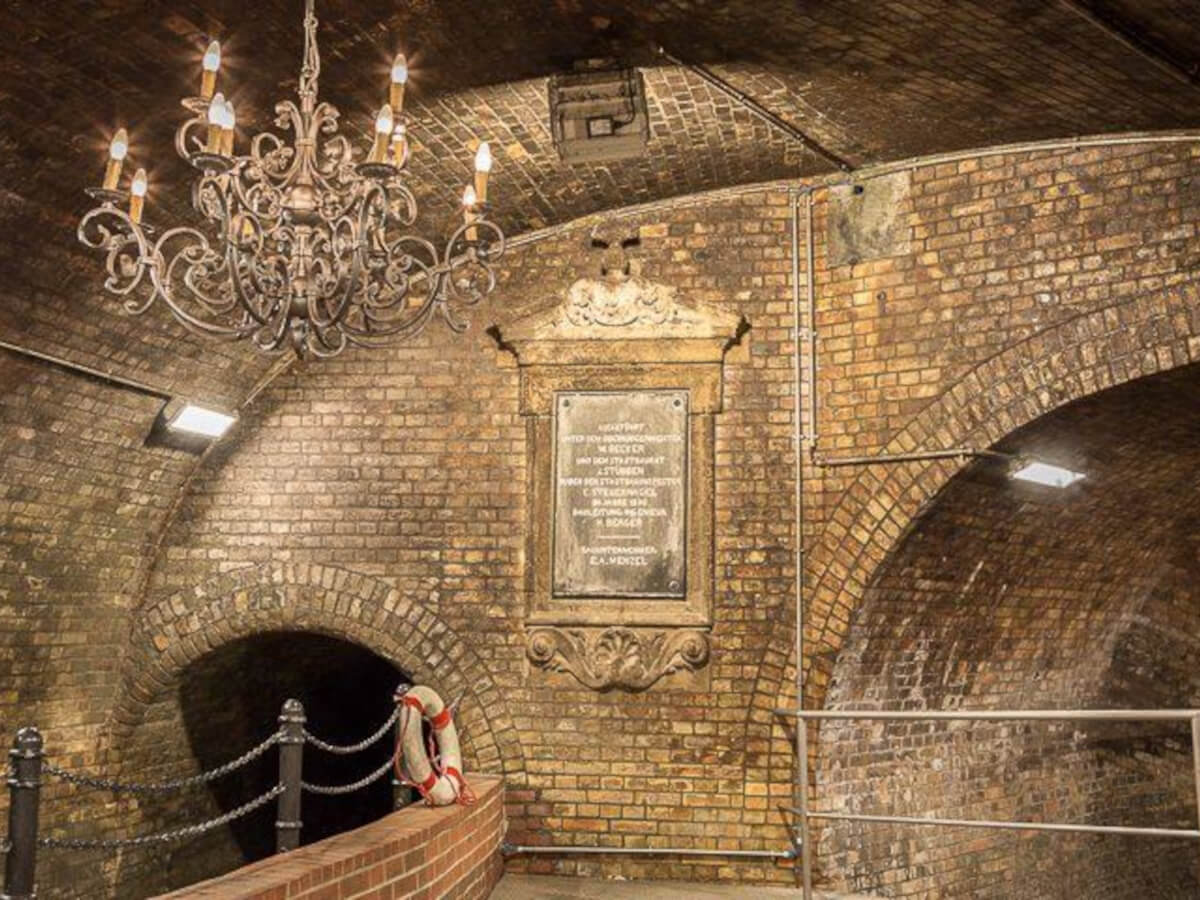
Expecting Wilheim II, the last German Emperor and King of Prussia to attend the opening was a great honor for the city. To commemorate the emperor’s visit, the city turned a storm water overflow structure into a banquet hall with a grand feast planned. They named the event venue Chandelier Hall (Kronleuchtersaal), installing two elegant 12-armed candlelit chandeliers hanging from the ceiling. To everyone’s disappointment, the emperor never appeared.
MECHANIZING THE COLOGNE SEWAGE SYSTEM
By 1905, the sewage system was mechanized to purify the waste before it was channeled into the Rhine. The system continued to expand to meet the growing population over the years.
THE CHANDELIERS
For over one hundred years, the Cologne Sewer System chandeliers remained hanging from the ceiling of the sewer. Left to rot in humid conditions, they deteriorated into a state of total disrepair. They were replaced in 1990 by a single large electric chandelier.
THE COLOGNE SEWAGE SYSTEM BECOMES A TOURIST ATTRACTION
The underground sewage system is now open for tours. One is still able to see parts of the 1st century Roman system in working order. Chandelier Hall remains part of the working drainage system for storm water. It has also taken on a new function, that of a concert hall. Having unique acoustic properties, the hall has hosted classical and jazz concerts since 2000. Covering almost 1,500 miles, the system is an odyssey from ancient to modern times.