
THE WOMAN WHO GAVE BIRTH TO RABBITS
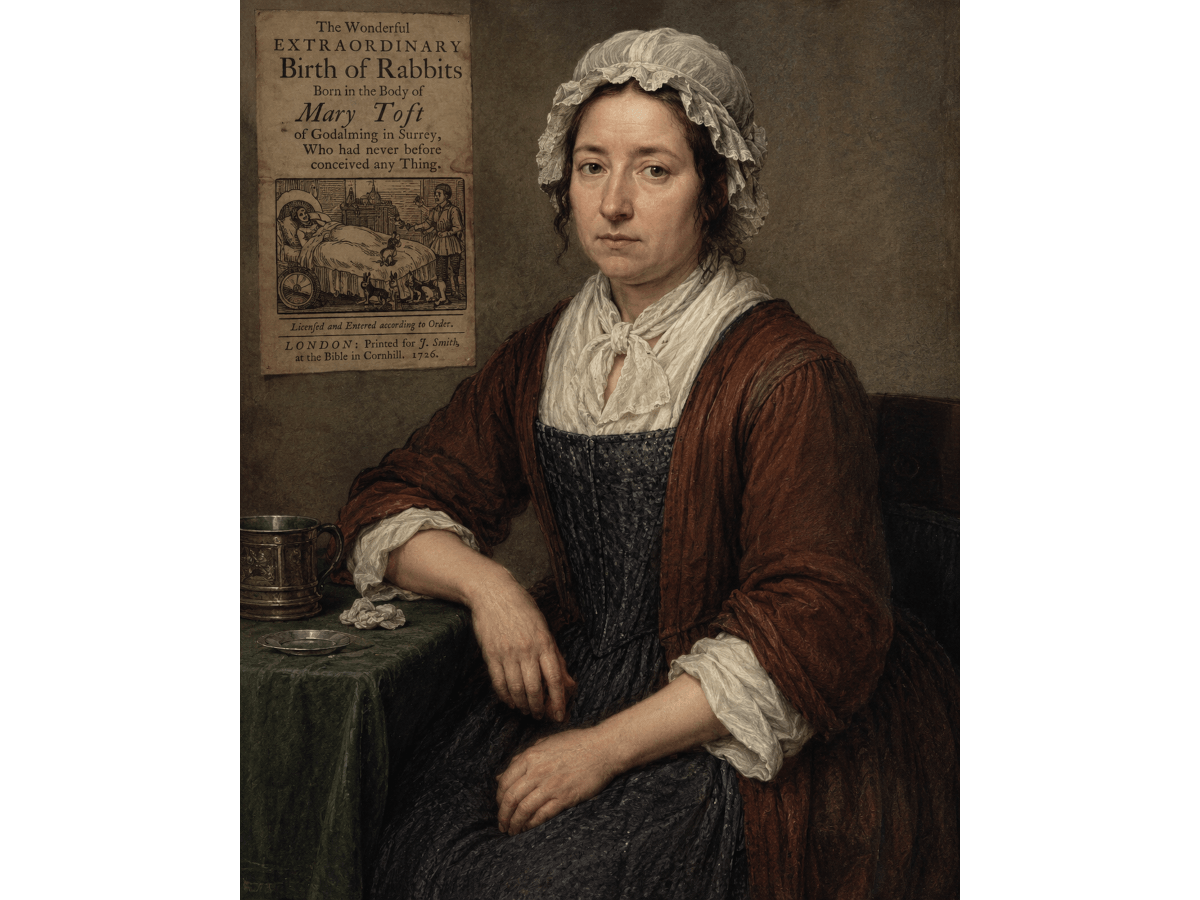
In 1726, Mary Toft, a twenty-five-year-old woman from Godalming, Surrey, England, pulled off one of the weirdest medical hoaxes in history. She claimed to have given birth to dozens of rabbits. A local surgeon, John Howard, assisted in the delivers. Several prominent doctors supported her story, convinced it was true.
HOW SHE CLAIMED IT HAPPENED
She asserted that while pregnant, she was walking in a field and was surprised by a rabbit that frightened her. Following this incident, she developed uncontrolled cravings for rabbit meat. After having a miscarriage, she discovered she was still pregnant. She started to deliver skinned dead baby rabbits and rabbit parts. At the time, it was a hotly debated subject in the medical community, if it was possible for women to give birth to animals. She instantly became famous.
THE KING OF ENGLAND WANTED TO GET TO THE BOTTOM OF IT.
King George I, sent the most renowned physicians in England, which included his Royal surgeon, Nathaniel St. Andre to scrutinize the situation and get to the bottom of it. The doctors concurred that Mary had given birth to rabbits. Some of the doctors insisted that they had witnessed this take place
When St. Andre definitely confirmed it was true, the King sent surgeon Cyriacus Ahlers to further investigate. He did not believe her story.
MARY WAS BROUGHT TO LONDON TO BE STUDIED
In London, Mary was put under a relentless series of examinations and rigorous assessments, during which time she stopped delivering rabbits. The 2nd Baron of Onslow, Thomas Onslow, decided to start his own inquiry and discovered Mary’s husband had been purchasing baby rabbits. A porter then confessed to having been paid by Mary’s sister-in-law to sneak rabbits into her chamber. She confessed to the hoax and was jailed for fraud.
THE AFTERMATH
The surgeons involved in supporting her claim were widely condemned. They were made public laughingstocks and subjected to far reaching mockery. Many of their careers were ruined. This incident resulted in a great loss of confidence in the medical community. It had an enduring impact on the public perception of doctors’ competence during this period. St. Andre staked his reputation on Mary’s deception and was ruined. The timing of her confession proved extremely problematic for St. Andre as he had just published a brochure, “A Short Narrative of an Extraordinary Delivery of Rabbets”. He lost favor with the King and died in poverty. Ahlers’ publication, “Some Observations Concerning the Woman of Godlyman in Surrey”, had raised serious doubts about Mary’s story. There was deep suspicion of collusion between St. Andre and Howard.
WHY DID SHE DO IT
No one can say with absolute certainty why Mary perpetrated the hoax. It appears that she was originally motivated by a deep need for attention and the belief that she would reap financial gains from her extraordinary story. She and the people around her who supported the ruse believed wealthy people would pay to see medical curiosities.
Strangely enough, during the 18th century, many doctors believed a woman could give birth to an animal due to the concept of Maternal Impression. This scientific theory held that a woman’s intense emotions, cravings, fears, dreams or shock could physically change a fetus. This was proposed by John Maubray, a respected midwife of the day. In his medical text he stated that it was possible for a woman to birth a monstrous crossbred beast he called, “sooterkin” if she has close contact with household pets. When Mary claimed to be shocked by a rabbit in a field which caused her to become obsessed with eating rabbit meat, it was not an outlandish claim at the time that she would give birth to rabbits.
In the end, her hoax spun out of control when prominent members of her community latched on to this situation for personal and professional gain, including her surgeon.
MARY’S LIFE AFTER THE SCANDAL
Toft spent a few months in prison and was eventually released without being charged. She returned to her old life. In 1727, she gave birth to a daughter with the Godalming parish register noting “it was her first child after her pretended Rabett-breeding”. She died in 1763, finding fame once again after death with her obituary having been posted with those of aristocrats.