
10 FOOT GIANT FOUND IN UPSTATE NEW YORK
On October 16, 1869, a 3,000-pound ten-foot petrified man was discovered while digging a well in the small upstate New York town of Cardiff, New York.
GIANTS WALKED THE EARTH IN THOSE DAYS
Cigar maker George Hull was an unwavering skeptic and atheist. In 1867, during a business trip to Iowa, he became engaged in a fiery battle of words with a revivalist preacher. The preacher firmly believed that it was ungodly to interpret the gospel. One must accept, he preached to his followers that the written word as final. This enraged Hull, believing the preacher was spreading lies. Specifically, the Book of Genesis statement “there were giants on the earth in those days”, infuriated Hull. He thought that to be preposterous. He was determined to get the last word and hatched a plan to make fools of believers.
HATCHING A PLAN TO MAKE FOOLS OF BELIEVERS
He determined that he would have a stone giant made and deceive everyone by passing it off as genuine. Always the businessman, he also saw this as a potential opportunity to make money off the scam. He purchased a 5-ton block of gypsum and sent it to a Chicago marble dealer. Hull cut him in on the scheme for a share of the profits.
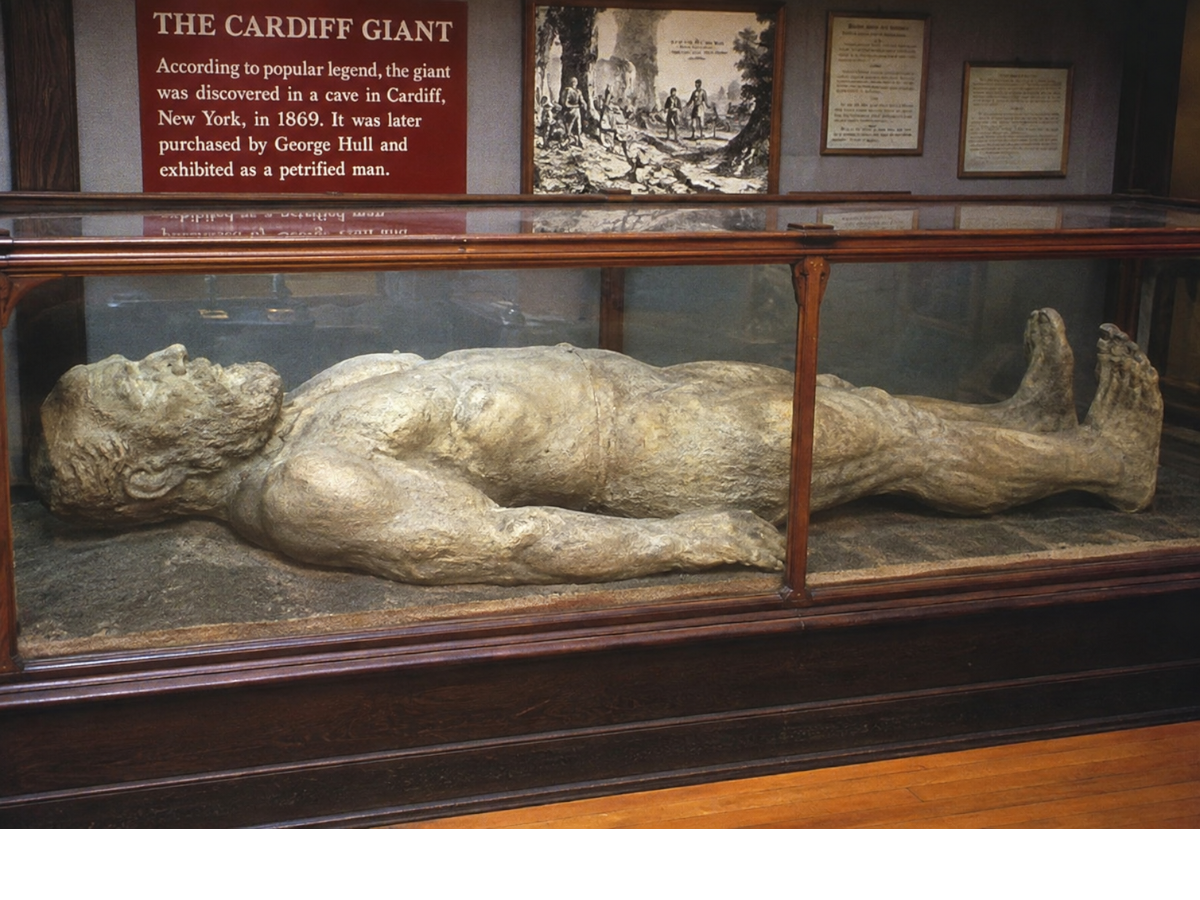
Two sculptors were hired to fashion the block of gypsum into a petrified man using Hull as the model. The final product was a 10-foot man lying on his back. One arm was on his stomach, and one leg was crossed over the other. Sulfuric acid was poured over the piece to give it an aged, weatherbeaten look. Hull stuck pins into the sculpture to duplicate skin pores.
ON THE ORIGIN OF THE SPECIES
The publication of Charles Darwin’s “On the Origin of the Specifies”, triggered a fire storm by advancing the theory of natural selection over divine design. This directly conflicted with the idea that humans were created in God’s image. Religious views during the mid-19th century were in flux, influenced by a traditional Christian framework that was being questioned by new scientific discovery. While there were theologians that maintained that evolution was God’s plan for creation, others vehemently challenged it. It was during this time of great debate that Hull set out to make fools of those people who believed in divine design.
PUTTING THE PLAN INTO ACTION
Farmer William “Stub” Newell was the brother-in-law of George Hull. After including Newell in his plan, Hull shipped the giant in an iron container to Newell’s farm. The two men buried the giant behind the barn. They wedged the statue under roots to make it appear that it lay there undisturbed for a millennium. After the burial, Hull went back home to Binghamton, New York and waited.
THE FIND ASTONISHED THE TOWN
In 1869, a year after the giant was buried, Hull instructed Newell to hire a pair of workers to dig a well over the spot where the statue was buried. After digging for a short while, the astonished laborers, exposure the sculpture. Quickly, the news spread through the town. Townspeople dropped everything and came to get a look at the discovery. The area was well known for scientifically verified fish fossils which made it easier for the public to accept the petrified man as real. They believed it was the body of an ancient human. A science lecturer announced it was not a man but a statue. He suspected was carved by French Jesuits long ago. In the middle of all this conjecture, Newell ramped up the drama by threatening to rebury the giant until his neighbors could prove to him, the giant was real. He and Hull wasted no time, however, setting up a tent around the giant which lay in a pit. They began charging 50 cents for the opportunity to spend 15 minutes standing over the pit, attracting over 500 people a day. Refreshment stands were set up. Then Newell built a shed to sell hot meals. Visitors came from surrounding towns by transport. Newspapers made it the biggest story of the day. There were two types of people who came to gawk at the petrified man, those who believed giants walked the earth and the fossilized man was proof; and those who assumed it was a century’s old statue.
Hull and Newell sold a three-quarter share in the giant for $30,000 to a group of local businessmen. To attract bigger crowds, it was moved to Syracuse and then to Albany, Boston and New York. Throngs of people converged wherever it was exhibited eager to determine for themselves if it was real.
SCIENTISTS SOUGHT TO PROVE IT WAS NOT A HUMAN
Scientists knew flesh could not completely petrify and sought to disprove the remains were human. Examining it at close range, it was immediately clear that it was a fake. They saw it was made of gypsum and had tool marks on the piece. This type of stone is soft and soluble, deteriorating over time in the wet, marshy soil. When confronted by the fact that the giant could not be human, Hull revealed his deception. As crazy as it seems, even after the giant was exposed as a fake, the crowds still flocked to see it.
CAN LIGHTING STRIKE TWICE FOR HULL?
Hull made $20,000 in the Cardiff Giant scam; which in today’s dollars would amount to half a million dollars. He would go on to attempt to duplicate his efforts as a con artist. Trying once again to hoodwink the masses, he built a 7-foot-tall giant with a tail in 1877 and buried it in Colorado. This time, no one fell for his scheme, causing him to sustain a large financial loss.
P.T. BARNUM WANTED THE CARDIFF GIANT
P.T. Barnum, the renowned showman known for promoting hoaxes and founding the famous circus with James Anthony Bailey tried to buy the giant. Despite his offer of $15,000, he was unable to purchase the oddity. Failing at that, he had a replica of the statue made from wood. At the World’s Fair, both the gypsum and wood giants were exhibited. Barnum’s fake giant drew bigger crowds than the original.
INTEREST WAS LOST IN THE GIANT
Over time, interest in the giant was lost. It eventually changed hands several times. In 1947, it was purchased by the Fenimore Farm and Country Village in Cooperstown, New York, where it is still on exhibit today.
There have been many hoaxes throughout American history, but none so famous or elaborate as the Cardiff Giant.