
WAS MERRIWEATHER CLARK MURDERED?
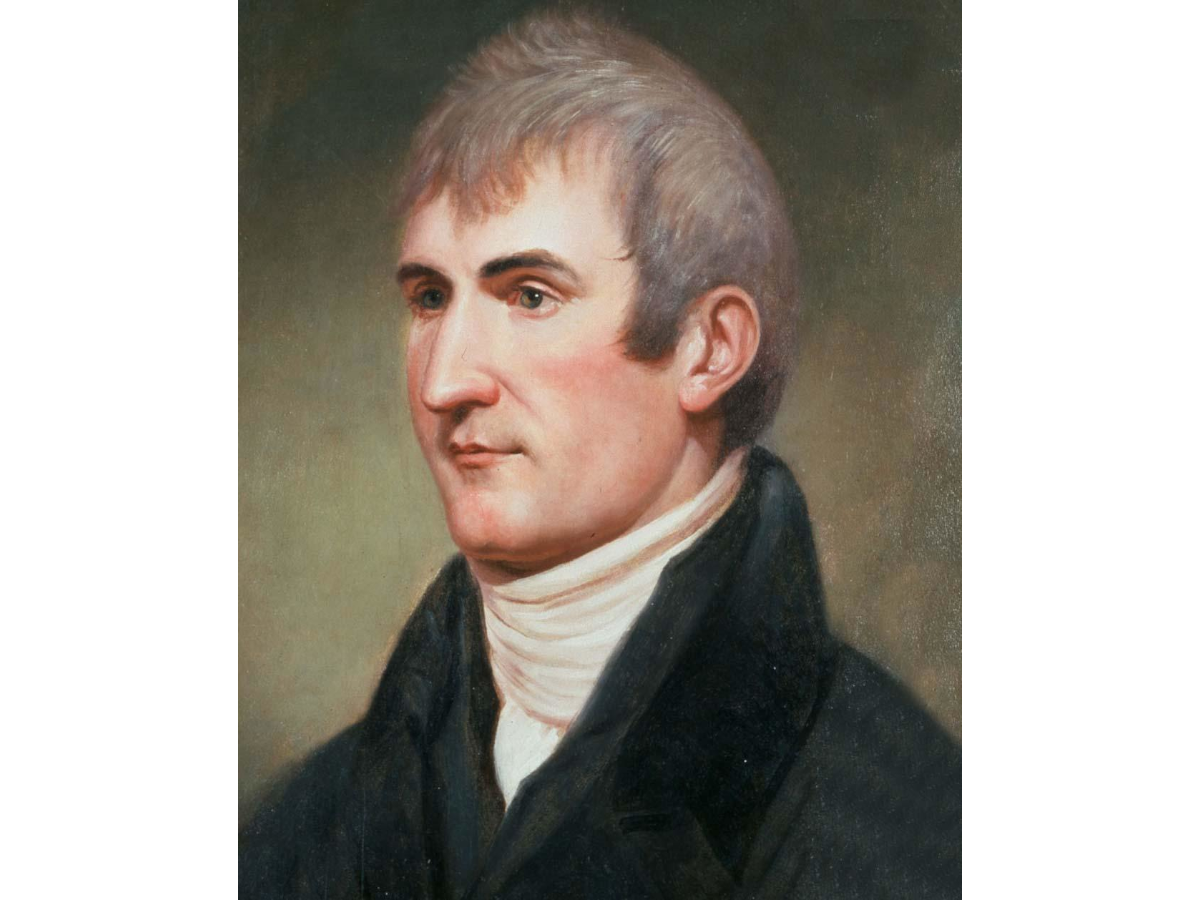
In 1803, the United States acquired an 828,000 square mile parcel of land from France known as the Louisiana Purchase. At a cost of $15 million dollars, it now makes up the western part of the United States. It extends from the Mississippi River to the Rocky Mountains and from the Canadian border to the Gulf of Mexico, almost doubling the land mass of the United States. Once secured, the President of the United States, Thomas Jefferson sent Merriweather Lewis and William Clark out into the unknown to explore this new territory. Did this set off a chain of events that caused the murder of Merriweather Lewis?
THE LEWIS AND CLARK EXPEDITION
President Thomas Jefferson authorized Merriweather Lewis and William Clark to lead a group of 30 men to map a route to the Pacific Ocean. Jefferson’s stated mission was to establish an American presence on the west coast before other countries tried to initiate their own claim and to find a Northwest passage. Such a waterway would connect the Atlantic and Pacific oceans creating a commercial hub for the young country. Additional objectives were to identify economic and scientific opportunities, determine where the Native tribes were located, their military strength and establish trade. During the expedition, Lewis and Clark developed relationships with 70 tribes who actively assisted them from becoming lost or starving. They drew over 140 geographic maps and documented natural resources and plants. The journey took them 8,000 miles into the unknown between 1804 to1806.
THE PROCLAMATION OF SOVEREIGNTY AND THE CONTINENTAL DIVIDE
In 1804, the expedition started at Camp Dubois near St. Louis and ended when they reached the Pacific coast in what is now Oregon. They returned to St. Louis in 1806. Jefferson issued a Proclamation of Sovereignty to claim title to each of the tribe’s lands and used military superiority to back up his claim. The expedition accomplished the goal of reaching the Pacific, allowing the United States to claim all tribal lands, but failed to find the Northwest Passage. When the men reached the Rocky Mountains, it became clear this barrier proved there was no continuous transcontinental waterway that could cross the United States. This barrier became known as the Continental Divide.
MANIFEST DESTINY
Driven by the concept of Manifest Destiny, Jefferson’s former belief in the cultural assimilation of native tribes, allowing them to become America citizens, dramatically shifted to demanding their forced removal. This rethinking of his beliefs was motivated by his desire for territorial expansion. He wanted the expedition to set in motion diplomacy with the tribes to acquire their land and establish trade. Engaging tribes in trade was a policy decision from Washington fashioned to force the natives into debt. This was a precursor to future policies that would coerce the natives off their lands to pay off their debt. Officially, the expedition was for exploration and to establish diplomacy with the natives. Its actual purpose was always to expand the country without regard for the native population.
MERRIWEATHER LEWIS
Lewis was a gifted outdoorsman and fearless explorer. He previously served in the Virginia Militia and the United States Army, raising to the rank of Captain. He then became Jefferson’s private secretary. When Lewis returned from the expedition, he became a national hero. In gratitude Jefferson appointed him the governor of the Louisiana Territory.
EMBARGO AGAINST TRADE WITH ENGLAND
In 1807, England attacked an American harbor, seizing a ship and taking the sailors prisoner. In retaliation, the United States halted trade with England. This embargo tanked the American economy, with exports dropping by seventy five percent. America became broke. Lewis was living in St. Louis administrating the Louisiana Territory. Due to the country’s financial problems, the War Department refused to reimburse Lewis for expenses he was incurring running the territory, forcing him into bankruptcy.
In September of 1809, Lewis decided to travel to Washington, D.C. to explain why operating the territory was so expensive. He needed to defend his reputation against the War Department’s claims that his reimbursement requests were not reasonable and to address political controversies from rivals. Politics in the territories were brutal and created bitter enemies.
LEWIS TRAVELS TO WASHINGTON D.C.
He intended to go to Washington D.C. by sea. He first traveled to Fort Pickering (now Memphis, Tennessee), planning to travel down the Mississippi River to New Orleans and then on to Washington, D.C. Due to the tentative situation with Britain and talk of war, he believed it was safer to travel by land. Having his journals with him, he feared they could fall into the wrong hands if the English attacked his ship. The 440 miles long Natchez Trace was the only dependable route from Louisiana and Mississippi to the eastern states. It was known as “The Devil’s Backbone” due to the lawless nature of this road. One could encounter danger from both bandits and the difficult conditions found along the way.
LEWIS’ EXPEDITION JOURNALS REMAINED UNPUBLISHED
Up to this point, Lewis had not been able to publish his journals from the expedition. Overwhelmed by trying to govern the Louisiana Territory and his mounting debt caused him to suffer from depression. There are also unsubstantiated rumors that he suffered from some unknown disease which was affecting his mental state such as malaria or syphilis. These distractions interfered with him being able to focus on the massive task of editing his journals.
THE NATCHEZ TRACE
On the 29th of September, Lewis left Fort Pickering joined by his free black servant, John Pernia and the US agent to the Chickasaw tribes, Major James Neelly along with his servant.
They reached Grinder’s Stand on October 10, 1809. Neelly remained behind searching for horses that had escaped the previous night. The proprietress, Priscilla Grinder, gave Lewis her cabin. She stayed in a separate detached kitchen while sending the servants to the barn. Mrs. Grinder claimed she heard two gunshots ring out during the night. She peeked through a slit in the door and professed to have seen Lewis crawling around on the floor pleading for water. She did not enter the cabin to assist him, stating she was too scared. There was much speculation about her account of the events. She continued to provide conflicting information about when she heard the shots fired and where Lewis was found.
DID LEWIS COMMIT SUICIDE?
By morning, he was dead. Jefferson was unusually quick to label it a suicide, while many suspected it was murder. Later in the day, when Neelly appeared, he had Lewis buried. His journals were eventually published in 1814, after William Clark commissioned Nicholas Biddle to edit them.
PERSISTENT RUMORS OF MURDER
There have always been persistent rumors that in addition to the stated goals of the Lewis and Clark Expedition, Lewis was given a secret mission by Jefferson. Could this have somehow led to a politically motivated reason for Lewis to be murdered? Could something Lewis found be of a threat to the young nation? Could Jefferson have told Lewis to look for any basis to the stories about an early Welsh presence in the West? A land that Jefferson had just paid $15 million for and was now intent on claiming for the United States.
DID ARTIFACTS LEWIS FOUND IMPACT JEFFERSON’S CLAIM TO LAND?
Did Lewis find artifacts that refuted Jefferson’s current claim that the natives were savages who moved around and had no ancestral lands or culture, therefore, allowing America free rein to take the lands?
THE MANDAN TRIBE
Author and painter George Catlin spent 14 years among native tribes. He was convinced the Mandan tribe were descendants of the Welsh who sailed to America in the 12th century in the company of the Welsh Prince Madoc ab Owain Gwynedd. He supported his claim by identifying Mandan words which were similar to Welsh, finding members of the tribe that had lighter skin and hair with ten percent having blue eyes. He also found them to be shorter than other tribes. Their boats were made from leather drawn over bent sapling frames just like Welsh fisherman. He was not even convinced that the Mandan were a native tribe. He wrote that they built established villages with well protected defenses surrounding the perimeter. They also extensively farmed. Other tribes roamed the Plains bringing their collapsible tepees with them. They also had a belief in a great flood which other tribes did not, making Catlin convinced in the past they had encountered the bible.
Stories associating the Mandan with the Welsh first turned up in 1580, when Dr. John Dee introduced Queen Elizabeth to the legend. Prince Madoc supposedly set sail for North America with a crew of 100 men. They returned to England with stories of a place to the west with bountiful lands. They went back on a second voyage with ten ships full of both men and women and were never seen again.
Additional English voyages recounted finding pale natives who spoke what they believed was Welsh. In 1608, an explorer reportedly found natives who called themselves Mandoag and spoke Welsh. For over 200 years reports cited contact with tribes who not only spoke Welsh but built blockades around their villages using stone and mud typical of the Welsh style. In 1799, the Governor of Tennessee, John Sevier recounted a story of five skeletons being discovered in brass armor with the Welsh crest near the Ohio River. There were other similar accounts in Tennessee and Alabama. A Cherokee chief told the story of forts that had been built along the Alabama River by a light skinned tribe long ago. None of the claims of Welsh Indians can be proven since the tribe was wiped out in1837 by smallpox. The disease dismantled the cultural and social fabric of Mandan society. The remaining 150 survivors merged with other tribes.
COULD ENGLAND HAVE HAD A CLAIM TO AMERICA’S WEST?
If Welsh explorers beat America to the West and it could be proven, the English could have a legal claim to ownership of the land. Wales has been part of the United Kingdom since 1535.
Clark brought back a massive number of Native artifacts, plants and animals from the expedition. They were turned over to the government. Rather than becoming a National Treasure, they were lost, destroyed or given away. Very few examples remain today. Why?
LEWIS RETURNS A HERO
Lewis returned from the expedition a hero; his life then fell apart. His mental state was deeply affected by his fall from grace. He sacrificed everything for his country and was now being treated very badly. Was he so angry that he refused to keep quiet about what he found? Could this have put him in serious conflict with Jefferson? Priscilla Grinder claimed she overheard men arguing in the cabin. Witnesses stated he had a gunshot wound to his head and half his brains were blown out. How could he have then shot himself a second time in the stomach? Who commits suicide by shooting themselves in the stomach? And what happened to his horse, money and papers which disappeared immediately following the shooting?
GENERAL GEORGE WILKINSON
Another interesting theory proposes that Lewis was killed on the orders of General George Wilkinson. He had been the first governor of the territory and a spy for Spain. He was also a double agent colluding with Vice President Aaron Burr in a plan to separate the West into an independent country. Theodore Roosevelt had stated, “In all our history, there is no more despicable character”. He was suspected of assassinating rivals, but this could never be proven. Wilkinson wanted to stop Lewis from bringing papers to Washington which documented his and mine operator John Smith’s crooked land deals. After Lewis’ death, these papers were given to a Wilkinson associate, Thomas Freeman for safekeeping and disappeared.
In 1848, the Tennessee State Commission located Lewis’ grave so that they could build a monument over it. It was the only time a doctor examined his body, 39 years after his death. In the official report, the Commission wrote that while it was long believed that Lewis committed suicide, “it seems to be more probable that he died at the hands of an assassin”.
LEWIS WAS A PROUD FREEMASON
Lewis was a proud freemason and always carried with him his Mason’s apron (Washington wore his Mason’s apron to lay the cornerstone of the U.S. Capital). After he died, the apron was found in his pocket. It was covered in blood. His apron is presently held in the Mason Lodge in Helena, Montana. In 1989 and again in 2010, DNA analysis of the apron found two DNA profiles, neither of which belonged to Merriweather Lewis. This supports the claim that Lewis was murdered and did not commit suicide. The government has repeatedly refused to exhume Lewis’ body which would determine once and for all, the cause of his death.
HISTORIANS BELIEVE LEWIS COMMITTED SUICIDE
Most historians accept that Lewis did commit suicide based upon his mental state at the time of his death. They cite money problems, the overwhelming job of running the Louisiana Territory, his inability to find a suitable wife and not being able to edit his journals. They point out that he failed to find a Northwest Passage, the main goal of the mission and most of the trading posts he set up did not even last by the time he returned from the exploration. Others further state that a man who spent his lifetime as an adventurer was ill suited for the pressure of administrative duties, which Jefferson foisted on him. These assumptions tarnish the reputation of a great American hero. No one can deny that he repeatedly risked his life in the service of his country only to have his legacy destroyed.