
CAMP CENTURY – THE SUBTERRANEAN NUCLEAR BASE IN GREENLAND
In 1951, the United States and Denmark entered into the Defense of Greenland Agreement. This accord gave countries that were NATO members the ability to build military bases in Greenland for the purpose of defending NATO allies and Greenland. The United Stated used this agreement as a green light to build an underground nuclear missile testing base in Greenland.
THE COLD WAR
After World War II, the United States advocated for democratic capitalism. The Soviet Union, on the other hand, erected a communist, dictatorial motherland. This created a ten-year bitter conflict with both nations competing to be the dominant world power. The countries never went to war, fearing nuclear obliteration, but the apprehension of war always hung over the world. It was in this environment that the United States wanted to build military bases in Greenland.
THE UNITED STATES BUILT THREE MILITARY BASES IN GREENLAND
Three air bases, Thule, Narssarsuaq and Soderstrom, were built by the United States in Greenland over the next ten years. They were intermediate-range strategic bomber bases which also acted as refueling points for the United States military. The United States also constructed a Ballistic Missile Early Warning System and a Distant Warning Line, to provide advanced warning of a Soviet nuclear attack.
Since that time, only Thule, which was renamed Pituffik Space Base, in recognition of the local indigenous people, is still in use. It has become a critical nexus for space surveillance, satellite command operations and early ballistic missile warnings. Situated 750 miles above the Arctic Circle, it is America’s northernmost base.
THE UNITED STATES THEN PLANNED FOR AN UNDERGROUND BASE
One hundred and fifty miles from Thule Air Force Base, the United Stated wanted to build a secret subterranean nuclear missile base. The benefit was clear to the United States; it would be in close firing range to the Soviet Union. Declassified documents released in 1996 indicated that this base, Camp Century was supposed to be the first of many underground nuclear sites in Greenland. The secret Pentagon plan was to build subterranean nuclear sites that would be extremely difficult if not impossible to target and could survive the first strike. This would give the United States second strike capabilities.
The official story would claim that Camp Century was to be a scientific research center, but in reality, it was a cover for the covert Pentagon operation, “Project Iceworm”, a testing ground for nuclear weapons. The plan was to quarry 2,500 miles of tunnels under the Greenland ice sheets to conceal and activate up to 600 nuclear missiles, without Soviet knowledge.
BUILT UNDER MIND BOGGLING CONDITIONS
In 1959, work began under unimaginable conditions. With snowfall each year of more than four feet, winds up to 125 miles per hour and temperatures under -70 degrees Fahrenheit, the Army Corp of Engineers needed to build a three-mile road to transport over 6,000 tons of materials to the site. Much of it had to be transported by bobsled.
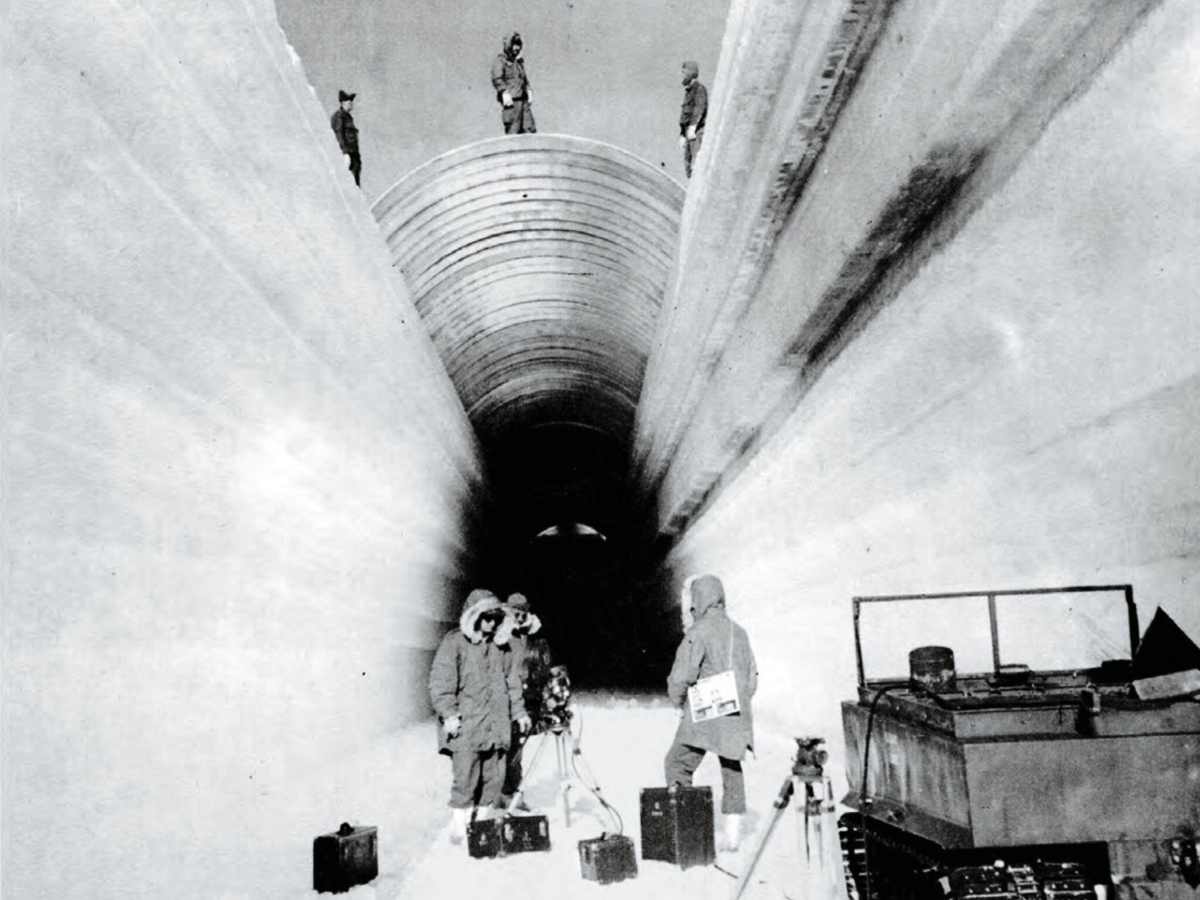
Deep trenches were dug in the ice, covered with steel roofs. Prefabricated wooden structures were set up in the trenches. Beneath the trenches, the Army engineers constructed Project Iceworm, the underground military complex. It contained not only launch sites and nuclear missiles but miles of railroad tunnels which could move and launch the missiles throughout the complex. It also contained a communication center, research labs and dormitories for military personnel. Amenities included a theater, hospital, recreational hall, barbershop, laundry, and church. The entire subterranean complex was powered by a portable nuclear reactor installed in 1960.
DENMARK HAD NEVER AGREED TO UNDERGROUND NUCLEAR SITES
The 1951 treaty, the Defense of Greenland Agreement, permitted the United States to build military bases in Greenland. It never covered underground nuclear bases. The Danish Prime Minister took the position that such a move could be construed as provoking the Soviet Union. When the U.S. Ambassador met with him, he further indicated that no plans had ever been submitted to his government for storing the waste and refused to discuss the matter. The Army construed his lack of response as approval and went ahead with the project.
IF CAMP CENTURY WAS SUCCESSFUL, PROJECT ICEWORM WOULD EXPAND
Had Camp Century been successful, the plan was to increase its size to possibly 100,000 square miles, six times the size of Denmark. This would have required 11,000 soldiers to live in the underground complex.
RESEARCH WAS ACTUALLY CONDUCTED IN THE FACILITY
Although calling the complex a research facility was a cover, polar research actually was being carried out. Researchers did make scientific discoveries including the first ice core drilling studies which revealed ancient climates and fossilized plants confirming that Greenland was once green. Studies were conducted on the movement of ice sheets, ways to mitigate Arctic whiteouts and how communication signals were altered by the aurora borealis and the magnetic phenomena near the North Pole.
THE COMPLEX WAS ABANDONED
The Army Corp of Engineers designed the massive underground facility in the belief that weather conditions under the ice sheets would maintain the integrity of the structure. Perpetual snow and ice buildup would encase the complex and preserve the base forever. This assumption turned out to be wrong. Shifting glacial movement and compressing ice sheets triggered tunnels to warp and collapse. This demonstrated that building a vast underground missile network was not possible.
In 1967, when tunnels started to collapse, an immediate evacuation was necessary. Only eight years after the complex was built for $8 million in 1959 (over $92 million in today’s dollars) it was abandoned. The devastating force of the repositioning ice was rapidly threatening the total collapse of the tunnels. No missiles had ever been deployed under the Greenland ice sheet at the time the project was canceled.
WHAT WAS LEFT BEHIND – THE TOXIC AFTERMATH
When the military base was abandoned, they removed the nuclear reactor core which had been used to power the complex. In the rush to escape the collapsing tunnels, they left behind the contents of the rest of the base. This included 635,000 gallons of biological sewage, 47,000 gallons of radioactive waste, an untold number of toxic PCBs and 53,000 gallons of diesel fuel.
CLIMATE CHANGE
Climate change has now led to an expedited rate of ice and snow thawing around the complex. It is expected that radioactive waste and various toxins will eventually leak into the environment. This now presents a severe threat to the Arctic ecosystems. Studies have shown that these toxic materials interact with water discharged from melting ice and snow. The now toxic water is gradually migrating. Currently, it is projected that major seepage from the ice sheets into the ocean will not occur before 2100. This could lead to the disruption of the ocean’s food chain with devastating effects.
POLITICAL RAMIFICATIONS
This has become a significant political issue between Denmark, the autonomous government of Greenland and the United States. No clean-up strategies are ongoing as no viable options to resolve this problem exist today. New technology will need to be developed to address the 136 acres of toxic and radioactive waste which are up to 200 feet below the shifting ice sheet. The only action in place is monitoring the situation through the Camp Century Climate Monitoring Program and Geological Survey of Denmark and Greenland. They are using climate monitoring and radar to track ice shifts. The United States current strategy is “monitor and wait”, postponing any decontamination until undeniably mandatory.
Greenland has taken the position that since Denmark agreed to allow the United States to build the base, they should be held responsible for the removal of hazardous waste in Greenland. The issues of the eventual clean-up and liabilities are currently a hotly debated topic.