
NANNY OF THE MAROONS
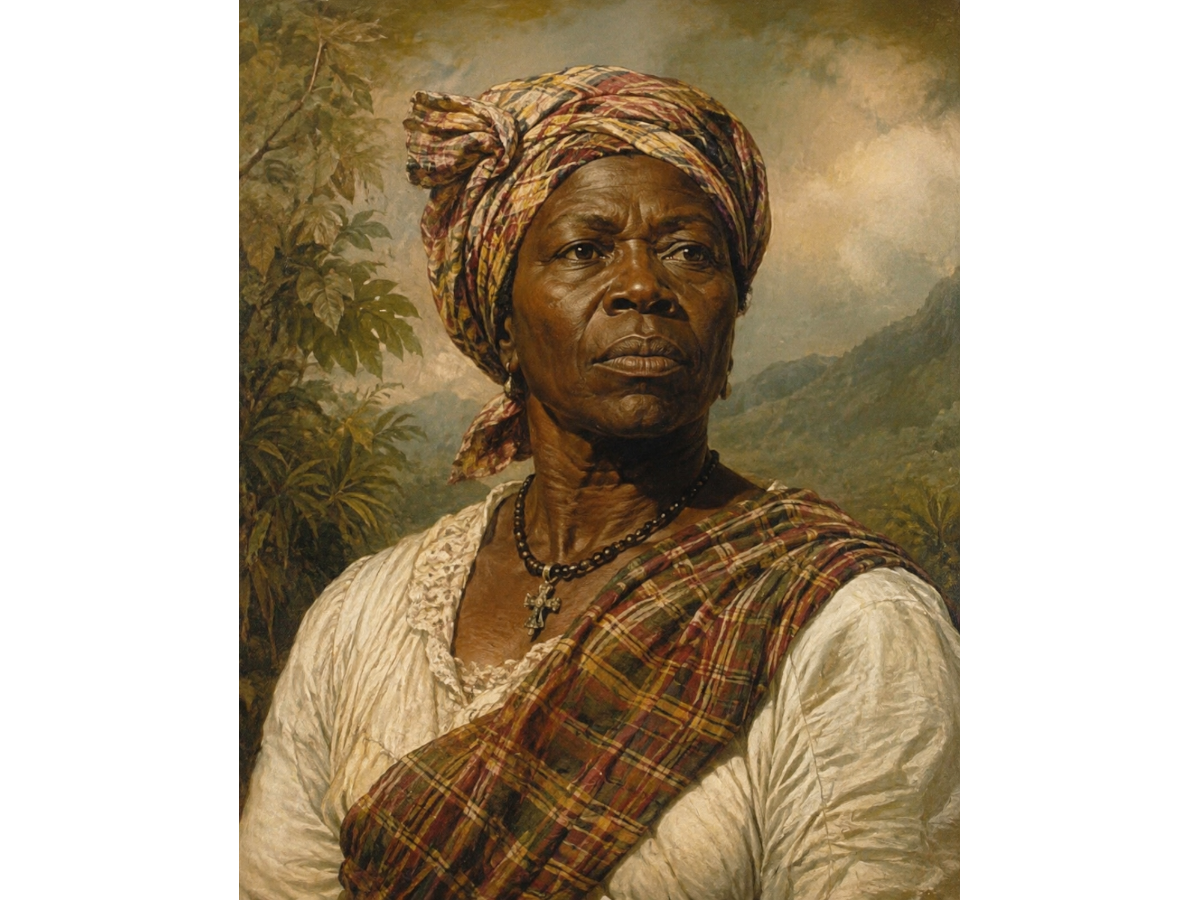
Nanny of the Maroons was born in Ghana between 1680-1686, into the Asante ruling class of the Oyoko clan. She was kidnapped on the Gold Coast of Africa and brought by ship in chains to Jamaica. She was enslaved on a sugar plantation. She escaped and went on to command the Jamaican Maroons, a society of escaped slaves. They mobilized and went to war against the British, challenging their enslavement. Using West African guerilla tactics, they became formidable enemies.
ENGLAND CAPTURED JAMAICA FROM THE SPANIARDS
In 1655, the English captured Jamaica from the Spanish. Spain officially surrendered in the 1670 Treaty of Madrid. In the confusion that followed the Spanish exit from the island, about 1,500 slaves bolted off the plantation and ran into the densely forested mountains and jungles.
NANNY’S ESCAPE TO THE MOUNTAINS
In the early 18th century, Nanny managed to escape from the plantation where she was enslaved. She made her way to the island’s heavily forested Blue Mountains of Eastern Jamaica. Nanny did not escape alone. By her side was her brother, Kodjo and four other men who she came to call her “brothers-in-arms”, Johnny, Quao, Cuffee and Accompong. This group, led by Nanny, did not just survive but was determined to save other enslaved Africans from bondage.
NANNY TOWN
The Jamaican Maroons would split into 2 groups, the Westward and Leeward. The main settlement of the Windward Maroons was Nanny Town, hidden among heavily forested mountains. It was built on a 900-foot ridge overlooking a river. This made it impossible for the British to attempt a forward attack on the community. The original members who joined Nanny were hundreds of slaves and their descendants who took advantage of the turmoil years, when the Spaniards fled the island. They had formed communities throughout the dense mountains.
She instructed her followers to plant crops, develop livestock farming and hunt down wild animals. There is a legend among the Maroons that during the formation of Nanny Town when food was scarce, she had them plant pumpkin seeds. They magically grew into full grow pumpkins in days under her watchful eye.
ATTACKING PLANTATIONS
Nanny organized and coordinated raids using guerrilla warfare to burn down plantations and steal their weapons and food. They guided hundreds of slaves into Nanny Town. Their freedom was conditional on joining the Maroons. She set up spy networks within the plantations and was able to communicate with them utilizing drums, horns and smoke. This enabled messages to be conveyed across the mountains alerting runaway slaves of British troop movement.
QUEEN NANNY BECOMES THE LEADER OF A REBEL ARMY
Nanny’s first order of business was to build a rebel army to challenge the island’s enslavers. While she grew her base, she sent the others out to find runaway slaves hidden throughout the island to join them. These men went on to form other maroon communities in the mountains.
THE LEEWARD MAROONS ARE FOUNDED
While Nanny founded the Windward Maroons, her brother, Kudjo founded the Leeward Maroons. Their communities were named after how the wind blows in Jamaica. With Windward meaning the side facing the wind and Leeward meaning the side protected from the wind.
MAROON TACTICS WERE CHALLENGING FOR THE BRITISH
The tactics the Maroons used proved incredibly challenging for the English. They were trained in conventional warfare on open battlefields. The mountainous terrain of Jamaica allowed the Maroons to strike and hide or quickly run away. Their use of ambush tactics to catch the English off-guard was key to their success.
Johnny and Cuffee played indispensable roles in logistics and combat. They commanded attacks against the British among the Maroon groups. They regularly raided plantations to ambush English soldiers, free slaves, confiscate guns and steal supplies. Quao joined Nanny to establish and operate the Maroons headquarters, Nanny Town. Accompong went on to found Accompong Town located in St. Elizabeth’s western parish of Cockpit County. Today, Accompong Town still operates as a semi-autonomous district. These communities established societies that were deeply rooted in West African culture.
THE TOPOGRAPHY OF THEIR COMMUNITIES KEPT THE BRITISH AT BAY
The Maroons established their communities deep in the jungles and mountains. The English, who were unfamiliar with such inhospitable terrain, were at a loss to try and track them. Even if the English could find their way into one of their villages, they could not defend themselves against the guerrilla tactics used by the Maroons.
NANNY’S ASHANTI MILITARY TRADITIONS
As the community expanded, Nanny taught her followers guerilla warfare utilizing her West African military traditions. It was based upon stringent tactical discipline coupled with deep spirituality. Warfare and religion were deeply interwoven in Ashanti tradition. Battles were understood to require mystical protection. Nanny taught her soldiers that when the enemy was near to stand absolutely still and cover themselves with leaves to appear to be trees. They used old style African horns called Abengs to send secret messages far distances and to coordinate military actions.
NANNY WAS AN OBEAH WOMAN
Enslaved Asanti people brought to Jamaica with them traditional West African practices. Nanny, acting as their spiritual leader, taught them these traditions to ensure they never lose their heritage. She was an Obeah Woman. This encompassed healing, spell casting, religion and spiritual practices from West Africa. She utilized these traditions to bring together and motivate her followers. The British believed that the Maroon’s success was based on Nanny’s supernatural talents and sorcery. They feared the ability it had as a tool to unite the enslaved people. They sustained heavy losses at the hands of the Maroons. Nanny used charms, knowledge of herbs and ancestral spirits to deliver support to the community. It is claimed that she could provide protection, undo curses and decipher dreams. She combined these skills with an inspired ability at guerrilla warfare.
THE JAMAICAN MAROONS NUMBERS GREW
As the British built new expansive plantations, they increased the slave population on the island. As enslaved Africans continued to escape the brutal life on the plantation, many joined the Maroons. Some stayed, while others formed their own communities in the mountains.
The Jamaican Maroons were dispersed into a number of separate communities concealed in the Blue and John Crow Mountains. This strategy allowed the movement to continue even if the English wiped out a single village. Each community was self-governing and invisible among the impregnable, densely thick forested mountains. Although independent, all resources were communally shared. This permitted them to engage the English in a coordinated guerilla war throughout Jamaica. They took their name from the Spanish word cimarron which meant runaway.
THE FIRST MAROON WAR
The Maroons were involved in two wars with the British. The first was between 1720-1739. The British were finally able to capture the Maroon’s major settlement, Nanny Town in 1734. This, however, did not spell the downfall for the Maroons. They still continued to wreak havoc on the British, causing several plantations to be looted and burned. They were able to plunder English supplies from all around the island. These Maroon techniques made it difficult for the British to establish new plantations. English manufacturers who depended on receiving sugar from Jamaica were seriously impacted by the rebel’s tactics.
The Maroons were relentless in their pursuit of the English. This led the British to propose a peace treaty. In 1739, the Leeward Maroon leader, Cudjo entered into the treaty with the English. He agreed to assist in apprehending runaway slaves and suppressing future rebel attacks in exchange for peace and the return of land.
The treaty only involved the Leeward Maroons. The Windward Maroons continued to fight for several more months. The English made five attempts to get them to sign a treaty, until Quao, the Windward leader finally agreed. Nanny and her followers refused to sign the treaty, feeling it placed constraints on their unconditional freedom. In 1741, she relented and was awarded 500 acres to rebuild Nanny Town, which had been destroyed by the English. It became known as New Nanny Town. Today it still survives as Moore Town
THE SECOND MAROON WAR (1795-1796)
The clash that started the Second Maroon War began when two Maroons were found guilty of stealing pigs. Their punishment was to be flogged by a slave. For fifty years, the Maroons were at war fighting to save enslaved people on Jamaica. Now that a slave flogged Maroons while other slaves looked on laughing was intolerable to the Cudjoe Town community.
When six Maroons went to the British to object. Instead of settling the matter, the new governor ordered their arrest. He then ordered British soldiers to destroy the Cudjoe Town settlement. The governor’s handling of the matter led to a resumption of guerilla warfare.
This started the conflict between the Maroons of Cudjoe’s Town who believed the British were violating the treaty Cudjoe had signed and the British colonists. Accompong Town sided with the colonists who controlled the land. The Windwards communities remained neutral.
THE MAROONS OBJECTED TO THIS TREATMENT
The English took big losses in the fight. They decided to employ a policy of slash and burn, making it impossible for the Maroons to obtain sufficient food, water and ammunition. The British then brought in bloodhounds to hunt down the Maroons, leading to their surrender. They agreed to capitulate on the condition they would not be deported. The treaty required that the leaders of the rebellion beg for the King’s forgiveness on their knees, then relocate to another part of the island and return runaway slaves.
After the treaty was signed, the Maroons were given three days to beg for forgiveness. Not trusting the British, the Maroons waited over two months to surrender. The British used this delay to claim a breech in the treaty and deported 581 Maroons to Nova Scotia. Conditions were so bad, many died. They pleaded to be deported to Sierra Leone in West Africa. The British agreed.
In 1838, after slavery was abolished, laborers from Sierra Leone were brought to work in Jamaica. Many of the deported Maroons were among them, including one of the men who was flogged, that caused the Second Maroon War.
NANNY’S LEGACY
Nanny of the Maroons died between 1750-1755 around the area of her beloved Nanny Town. She was the distinguished leader of the Windward Maroons for over thirty years. Her leadership was based upon her unmatched military brilliance, unparalleled accomplishments freeing slaves and spiritual influence over her community. She safeguarded their African heritage making sure their customs, history and legends were not forgotten. This cultivated a profound sense of unity among the Maroons.
Nanny of the Maroons remains a national hero in Jamaica and was given the honor or appearing on the Jamaican $500 bill.