
WHY ARE WITCHES ASSOCIATED WITH QUAKER WOMEN?
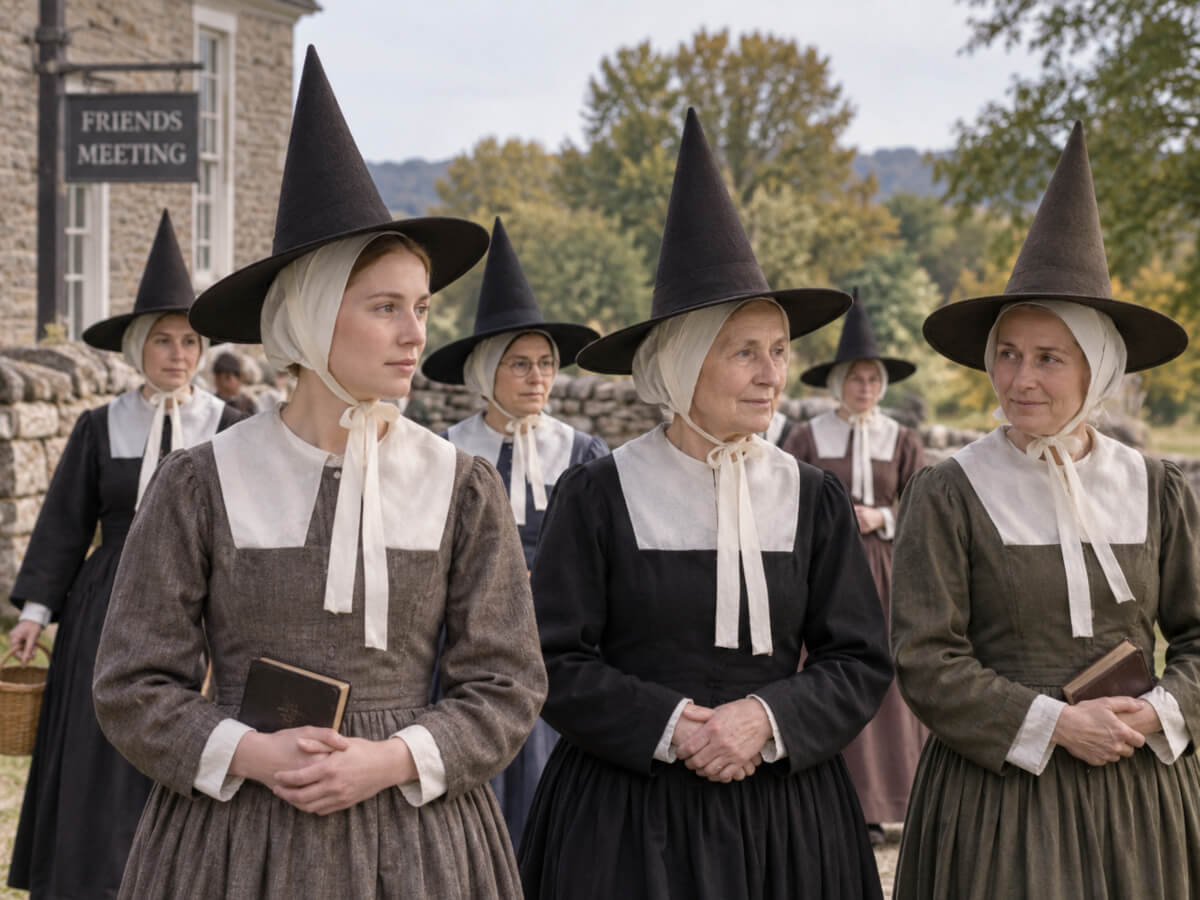
The most enduring characteristic of a witch is her tall pointy hat. Who would have thought that image came to us through the Quakers and their feminist beliefs.
THE QUAKERS ARE ESTABLISHED
In 16th century England, the establishment of a new Christian denomination, the Religious Society of Friends was revolutionary. Their belief that women were equal to men and could play an active role outside the home, and could even be preachers, sent shock waves through the Church of England and the Monarchy. They were harassed and thrown in prison. Quaker women in particular were in danger and accused of witchcraft.
As the movement took hold, their members underwent a spiritual awakening. During these encounters they would shake (quake). As a result, they became known as the Quakers. Puritans and Anglicans saw this as a sign of witchcraft. They viewed this as an indication that Quaker’s practices had invited the devil into their lives.
HOW QUAKER WOMEN DRESSED
Quaker women in the 16th century practiced “Plain Dress”. Denouncing vanity, they dressed in working class, drab basic style and colors. This typically included head coverings, long skirts, aprons and wool bodices. Their clothes were stripped of all ornamentation. They rejected ribbons, lace and bows. Their head coverings frequently took the form of the common hat style of the period, tall black felt pointy hats which today are associated with a witch’s hat. They were no different than what was in fashion at the time . Called a capotain it was also known as a puritan or pilgrim hat.
People of the day practiced “hat honor”. This was the tradition of tipping one’s hat in a sign of politeness to your social superior. Quakers refused to abide by this convention Because of this, these capotain hats became more closely associated with them.
When fashion trends moved on and tall black hats stopped being worn, Quaker women continued to wear them. It was a choice to wear modest clothes and avoid fashion trends. Since only Quakers retained this style, folklore merged the unconventional Quaker women with witches.
By the 18th century, Quaker dress code became more rigid. Their hat style was then considered too pretentious. Women started wearing the brims of their hats pulled towards the face for modesty.
By the 19th century, this transformed into the classic Quaker bonnet. These dark, hard capote-style bonnets had quilted long brims and were gathered at the back. They were tied under the chin with a simple ribbon. Despite no longer wearing the capotain, they continued to be associated with them.
COLONIAL AMERICA
Strongly opposing the Quakers in 17th century Colonial America were the Puritans. They demanded authoritarian religious conformity in a tightly controlled, male-led church. They relied on rituals and sacraments to deflect evil spirits.
The Quaker’s belief system was based upon an “Inner Light” which was a divine presence that existed within everyone. This permitted individuals to directly experience God without requiring a priest or minister. Instead, at communal meetings, they would sit in silence until the Inner Light spoke through someone in the room. Sharing that message with the group, they attempted to collectively find divine guidance.
In the Massachusetts Bay Colony where the Puritans were the colonial authorities, these religious differences resulted in violent persecution of Quakers. Anti-Quaker laws were passed which subsequently brought about public whippings, prison and execution. The same held true in Virginia and New York.
At all times, Quaker communities in Colonial America were under surveillance by their neighbors, frequently, being accused of witchcraft.
THE AMERICAN REVOLUTION
During the American Revolution, the Quaker’s pacifist beliefs led to direct conflict with the Patriots. The Quakers refused to bear arms or take sides in the conflict. This led each side to believe the Quakers were spies. They were forced to pay exorbitant taxes for their military exemption. In refusing to support the Revolution, many Quakers had their property confiscated and were sent to prison.
They were frequent victims in early American history because they consistently posed a threat to religious, social and government conformity. In the early 1800s, Quakers were well represented in the westward migration movement in an attempt to flee being marginalized. Moving on, however, did not stop their social and politic isolation because they would not take a loyalty oath or participate in war.
A FRACTURE WITHIN THE QUAKER COMMUNITY AFTER THE REVOLUTION
In 1827, the Quakers broke into two distinct groups representing traditional beliefs and evangelical dogma. The Evangelical Quakers adopted the “Second Great Awakening”. This included traditional Protestant sacraments of communion and baptism, planned sermons, and the supreme authority of the bible. The Evangelicals focused on missionary work and converting new members which traditional Quakers were opposed to. They instead focused on social reform, playing a big part in women’s suffrage, Native American rights and the abolition of the slave trade.
QUAKERS TODAY
Today, while the original Puritan movement disappeared, the Quakers continue to be an active, global faith organization. The Evangelical Friends Church continues to operate as a mainstream Protestant denomination with Quakers functioning as a progressive religious wing.
QUAKER WOMEN, WITCHES AND FEMINISM
There is a deep communal history between Quaker women, Witches and Feminism. Their common thread is their challenge to patriarchal control and moving outside the traditional established rules. The ability of Quaker women to operate outside conventional social norms led directly to 19th century feminism.
The Quaker belief system held women to be equal to men. This challenged the existing social norms of the day. The establishment needed to take a strong position against such freedoms to ensure women retained their inferior status. This cast great suspicion on Quaker women and made them easy targets for accusations of witchcraft and sorcery. Overtime the lines blurred between Quaker women and witches.
WITCHES IN MODERN CULTURE
The movie “The Wizard of Oz” permanently fixed the imaginary of a witch in modern culture as a hooked nosed crone dressed in black with a full cloak, tall, pointed hat and warts, holding a broomstick.